to Mystic Seaport
24 Sep 2026
We've had a series of busy days and short boat runs and now have paused to hunker down in Manhasset Bay in Long Island as a Low pressure system hangs out to the south of Long Island and brings nasty ocean seas and winds along the east coast from Virginia to Cape Cod. Port Washington is the town here, and while we had stopped in the bay on our way northeast to Nova Scotia, this time we made it ashore and had a good walk down Main Street. The huge houses lining the bay are all also still here as we make our way southwest towards Virginia.
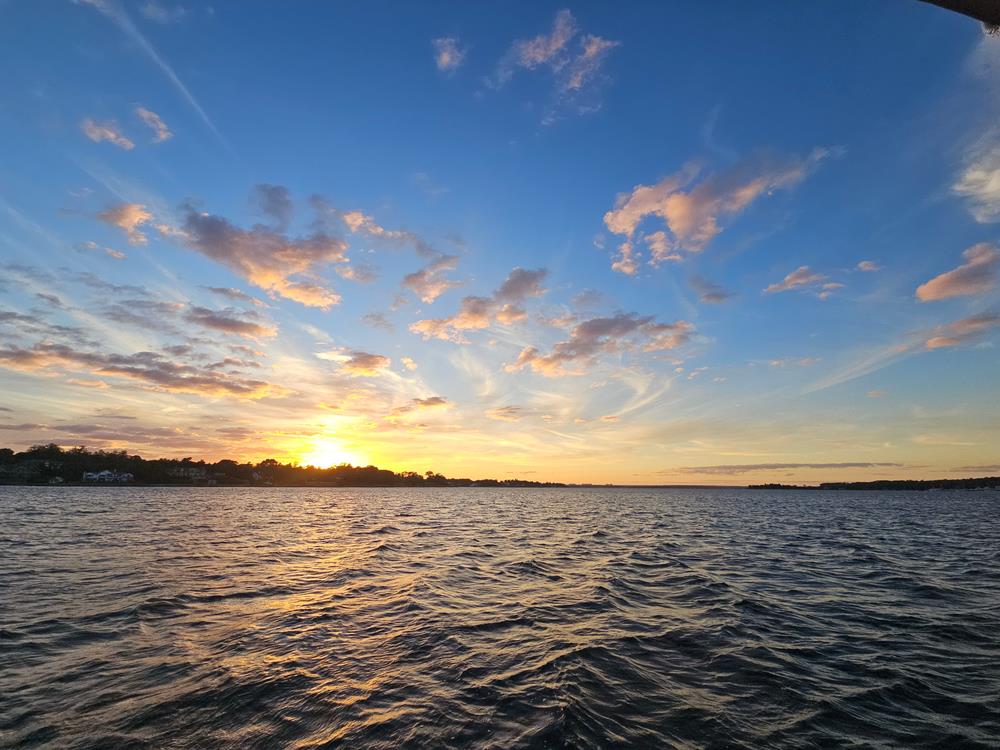
Sunset in Manhasset Bay, the clouds were quite good last night.
Following our overnight at Cape Cod anchored out in front of Provincetown, we timed our transit through the Cape Cod Canal to coincide with ebb tide (which oddly flows from the ocean into Buzzard's Bay). The forecast called for a light NE breeze from behind which makes for flat water on the Buzzard's Bay side of the canal. The cruising guide noted that in a strong SW wind the ebbing water will exit the canal and turn into steep square waves as the water crashes up against the wind waves, making the Buzzard's Bay side somewhere between rather exciting to dangerous (10 foot square waves, anyone?). That's what we were lucky to avoid and instead had a super nice flat Buzzard's Bay to float around on.
It was mid-afternoon when we exited the canal and it's a long run to Mystic Seaport, so we elected to cross over and anchor outside Cuttyhunk rather than ask Roadrunner to rush across the Sound. Roadrunner likes to proceed in a stately fashion, no rushing, which makes for pleasant crossings on the water. Fun part about Cuttyhunk, aside of the name, is that the tall ship Shenandoah is home ported on Martha's Vineyard, some 15 miles away, and late in the afternoon a tall ship appeared and it was... the Shenandoah. Turns out they don't have an engine, sail as a training ship, and when the wind died out they very slowly arrived, dropped headsails, turned up and dropped anchor nearby. It was interesting to see how the topsails are furled from the deck, lots of crew needed to lower and tie off the three jibs, and then carefully lowering the gaffs to get the main and mizzen down. Everybody slept well that night.
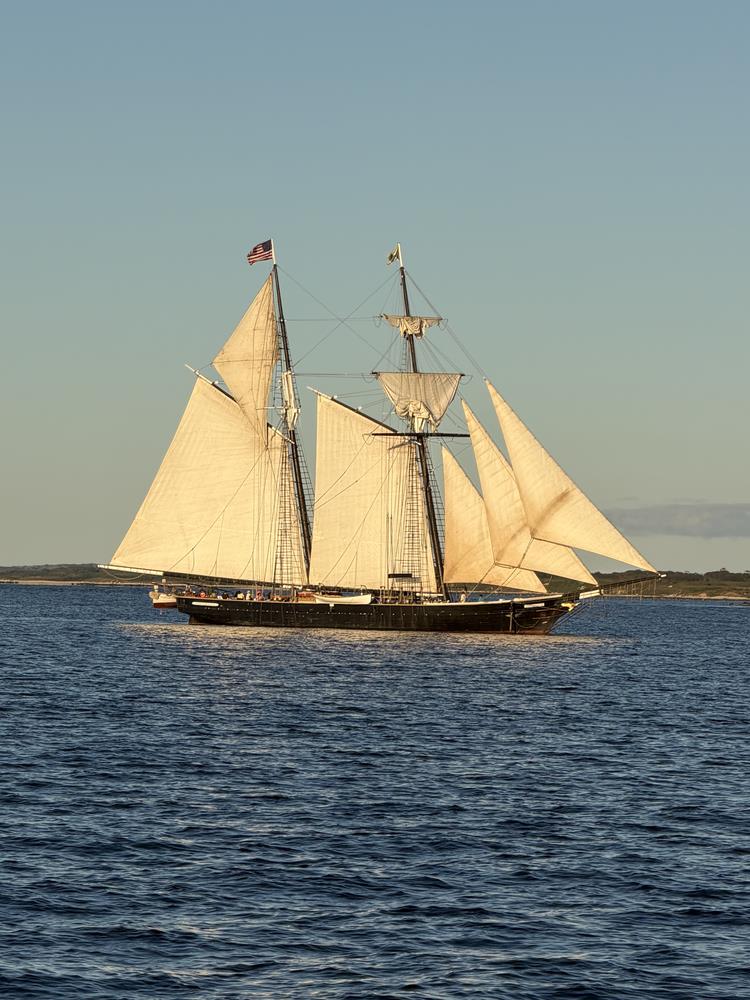
The Shenandoah pulling up to drop anchor a short distance away. The forward topsail is already furled, the lower forward topsail is in process of being furled. Neat how they can do that from the deck.
Come morning we were off towards Mystic Seaport, with the intent of anchoring at Mason Island and then take our dinghy two miles up the river to visit the seaport museum. That worked out well, and we're finding that the anchorages in Long Island Sound are filled with moorings which makes it a bit of a challenge to find a spot with suitable room for swinging at anchor. The anchorage Mason Island's east side has moorings out to the "channel" in, but there was room for us to split the distance between the yacht club moorings to port, the many other moorings filling in the bay ahead, the private moorings to starboard, and the rocks behind us. We settled in and Rina plotted distances to things we didn't want to hit on our anchor watch iPad running AquaMap.
Turns out that Mystic Seaport is not as far away as it looks on the charts, Mason Island is not that big, and the river is filled with moorings and moored boats as we dinghied up in the morning. There are two bridges to get through, both of which would have to be raised for Roadrunner but with the dinghy it was easy - no trouble going under the 7 foot clearance of the railroad bridge and was a tighter squeak under the 4 foot clearance of the town's road & foot traffic bridge. Beyond that is the seaport to starboard.
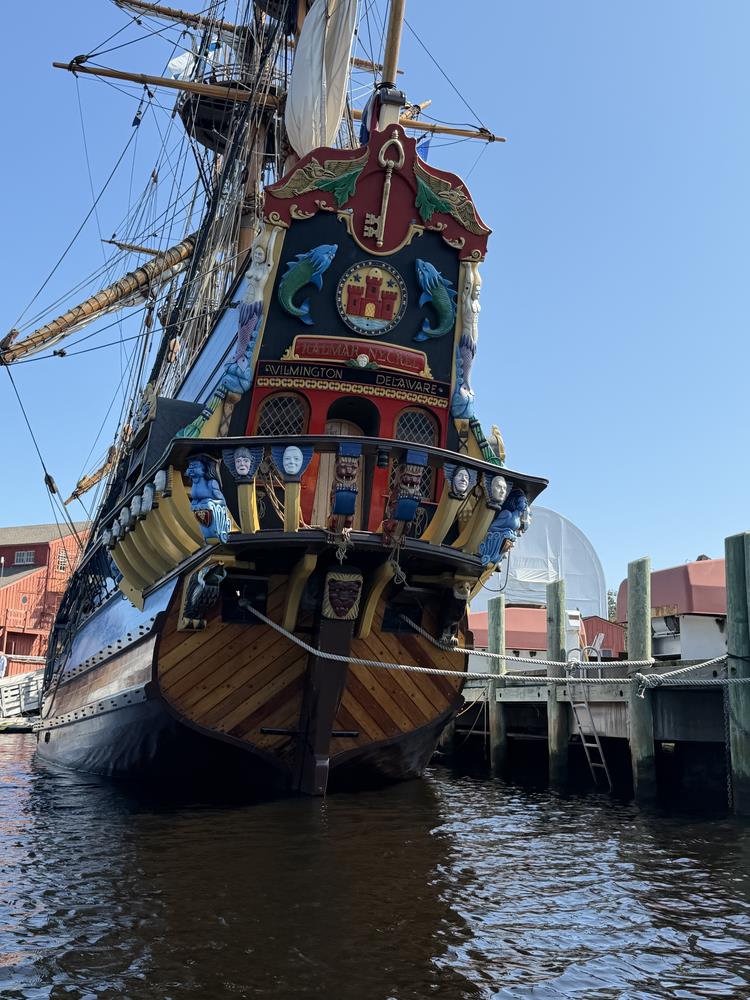
The first thing we saw when arriving at the museum is the stern of Kalmar Nyckel. The crewmember we talked with later said that if you're a big part of the program then they will create a carving for you on the transom. That's where the various faces come from.
Rina spotted the semi-large "Dinghy Dock Here" sign at the museum, we tied up, paid the entry fee and had the day to visit the many buildings on the site, talk with the shipwrights rebuilding a 100 foot wood sailing boat (a competitor to the Bluenose), walk through the whaling ship Charles W Morgan, and perhaps most interestingly talk with a crewmember of the Kalmar Nyckel. The Kalmar Nyckel had just finished up a refit and repaint of their ship, and they were waiting for a weather window to head down to Delaware where the ship is home-ported. Kalmar Nyckel is a replica of the 1627 ship built in the Netherlands that arrived in North America in 1638 bringing people that founded the colony New Sweden in Delaware. The Dutch were already there and New Sweden didn't last very long as they didn't play well with the Dutch West India Company, and after some fighting over forts New Sweden was defeated in 1655 - but the Kalmar Nyckel was an early boat into Delaware and thus the replica. The ship looks like something out of Disneyland and it was right there in front of us and fascinating to see what a trans-ocean ship from that time frame was like. We spent quite a while talking with a crew member while they were loading up for the run south.
The rope walk building is there, it's one of the things I remember from visiting here when we lived in Larchmont and sailed to Mystic on Scotia - really fun to walk into the building and see the equipment used to construct ropes and cables (rope is what we call three-strand today and cables are multiple ropes twisted together, I found out). A really good day at the museum.
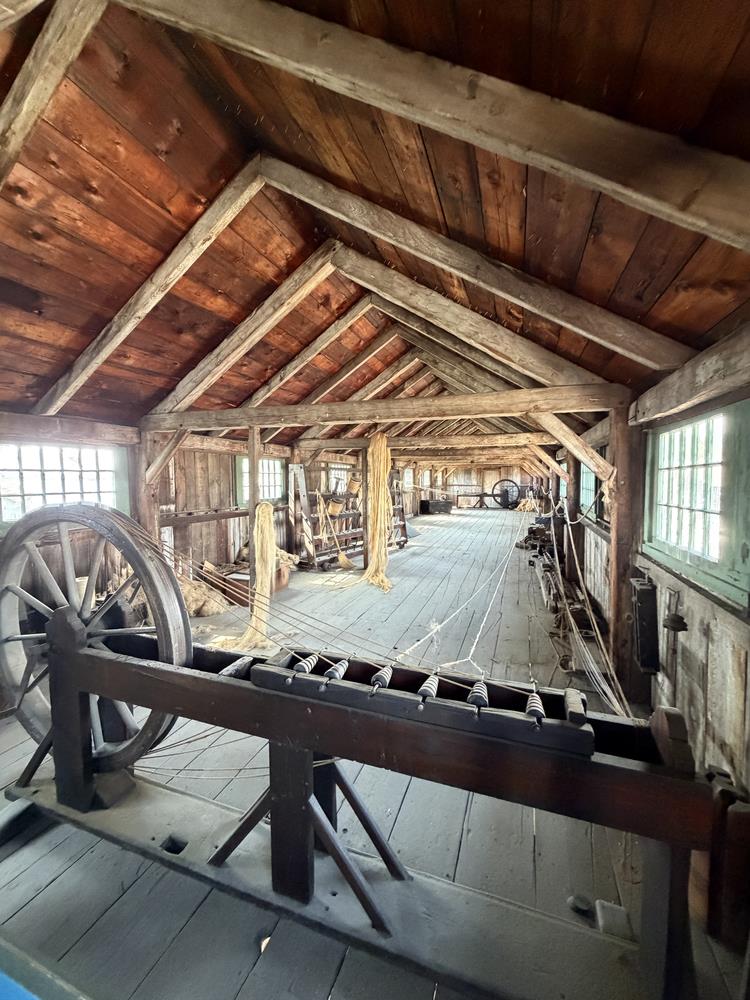
The rope walk, at the starting end. This is the spinning machine that rotates the cone-shaped spindles mounted in the wood frame. As the wheel is rotated it drives the cones, which creates yarns from the fibers attached to the end of the spindles and head off down the walk. Later the yarns are combined into strands, etc. Eventually you get a rope!
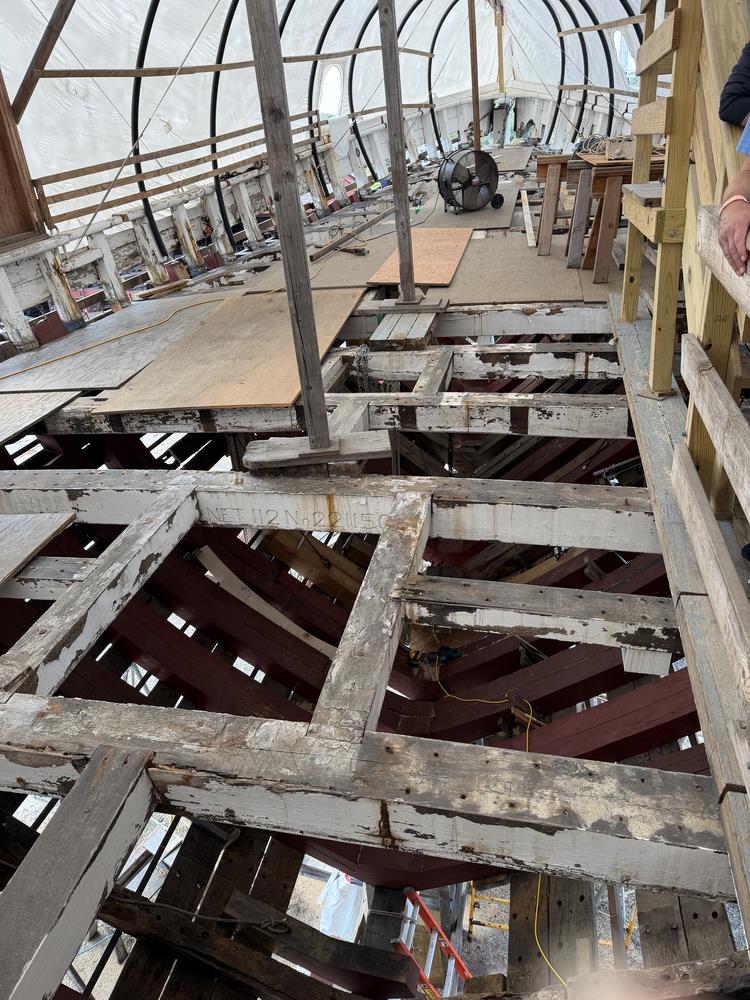
The interior of the fishing schooner L.A. Dunton during replacement of most every piece of wood on the boat. The white grid comprises the deck beams, below that the red-painted wood is new, everything else is in the process of removal and replacement. Most of the wood has been worm-damaged significantly over the years. The Museum is a complete wood restoration ship yard, and even operates two mills to take the trees they bring in and create their own lumber.
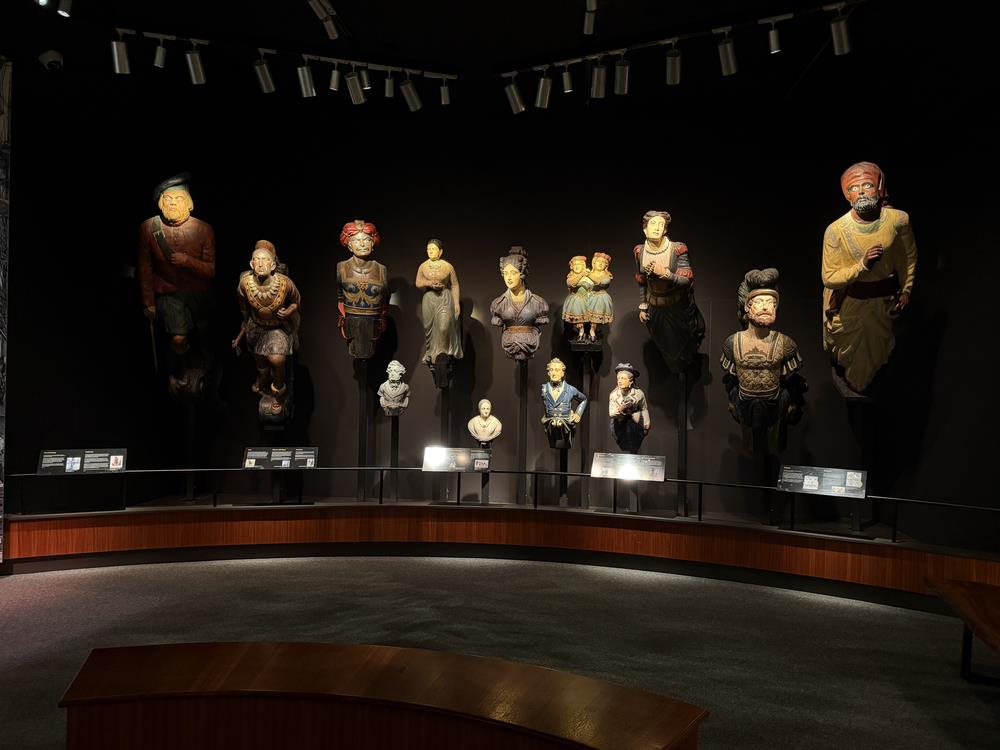
A selection of figure heads, is one of the more elaborate displays with fancy lighting and dark background to bring out the colors in the wood. The Museum has a carving building where they work on new name boards and figure heads.
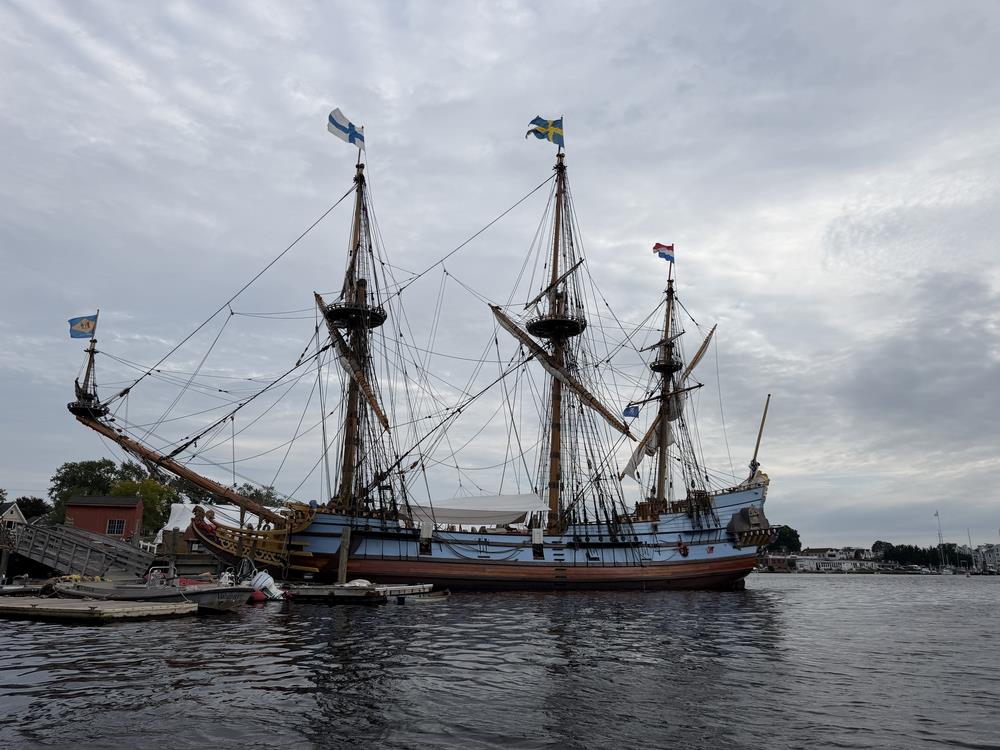
The Kalmar Nyckel waiting for the tide and bridges and weather to align so they can exit the river. My favorite part of the boat is the little saucer cup on the end of the bow sprit, complete with a cross-arm and sail. The crewmember told us the forward sail doesn't do much for speed but has a lot to do with how well the boat can be steered, so it is used to manage weather helm.