Sneaking through Three Rapids!
One of the interesting things about Octopus Islands and Waiatt Bay is that the anchorage is sandwiched between three tidal rapids. You really can't enter or leave this anchorage without dealing with at least one tidal rapid. On the way in from the south, you enter through Beazley Pass. Going north, you have your choice of either Hole in the Wall or Upper and Lower Rapids in Oskiollo channel . We wanted to use Cordero and Chancellor Channels to bypass a significant part of Johnstone Strait because Environment Canada has been consistently predicting 20 to 30 knots northwest winds (on the hose). However, that path actually required us to run four rapids right in a row (and, in this case, on one tidal exchange). The four rapids are:
- Hole in the Wall is a narrrow channel that connects Waiatt Bay to Calm Channel. The eastern end of Hold in the Wall is a tidal rapid.
- After you come out of Hole in the Wall, the next rapdi going north is Yaculta Rapids.
- Then you pass throguh Gillard Passage
- and finally Dent Rapids.
There's only about 15 minutes difference between the slack time at Hole in the Wall and the slack at Gillard Passage, so there's no way you're going to get through all four of these rapids exactly at slack.
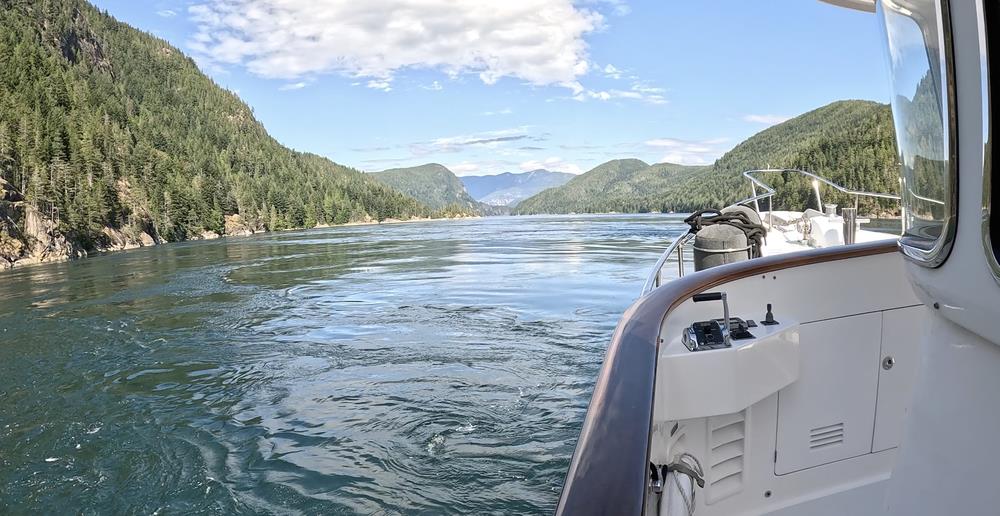 However, our semi-diurnal tides (two high and two low tides each day) generally have one larger cycle and one smaller cycle each day. The smaller the tide swing, the less violent the rapids are (because there's less change in the tide height) and the longer the period of safe passage. So, we waited for the smaller tidal exchange in the afternoon.
We arrived at the first rapid--Hole in the Wall--about 30 minutes before slack, so we knew some current would still be running. Fortunately, with the smaller tidal exchange, there was minimal whirlpools and overfalls. The remaining current was with us, so we got pushed through the passage at up to 10 knots. I generally prefer to run rapids with tide against us so that we're not being pushed through so fast. In this case, I needed the extra time to get to the other rapids on time.
We passed through Yuculta Rapids, Gillard Passage, and finally Dent Rapids--arriving at Dent Rapids and the famous "Devils Hole" right at slack.
There's a mark on the chart for a large and very powerful whirlpool that develops on almost every significant tide exchange in the same place. I saw it many years ago in full force from the deck of a charter fishing boat with an experienced captain who took us as close as he dared. It was a terrifying sight with a smooth-walled whirlpool that can be as much as 200-300 yards across where the center of the whirlpool just disappears into a giant hole! Definitely not a place you want to be on virtually any boat! Even the experienced guides in the area avoid Devil's Hole.
Shoal Bay (and the Pub that is no more)
We got through all four rapids unscathed and set a course for Shoal Bay. There's a city dock there, but we would be arriving late in the afternoon, so I expected it would be full, as it was. There's reasonable anchoring depths close to the end of the dock, so we set an anchor for the evening. the Waggoner's cruising guide talks about a Pub that was there, but it closed at Covid and never re-opened. We had been looking forward to a a greasy pub burger, but it was not to be!
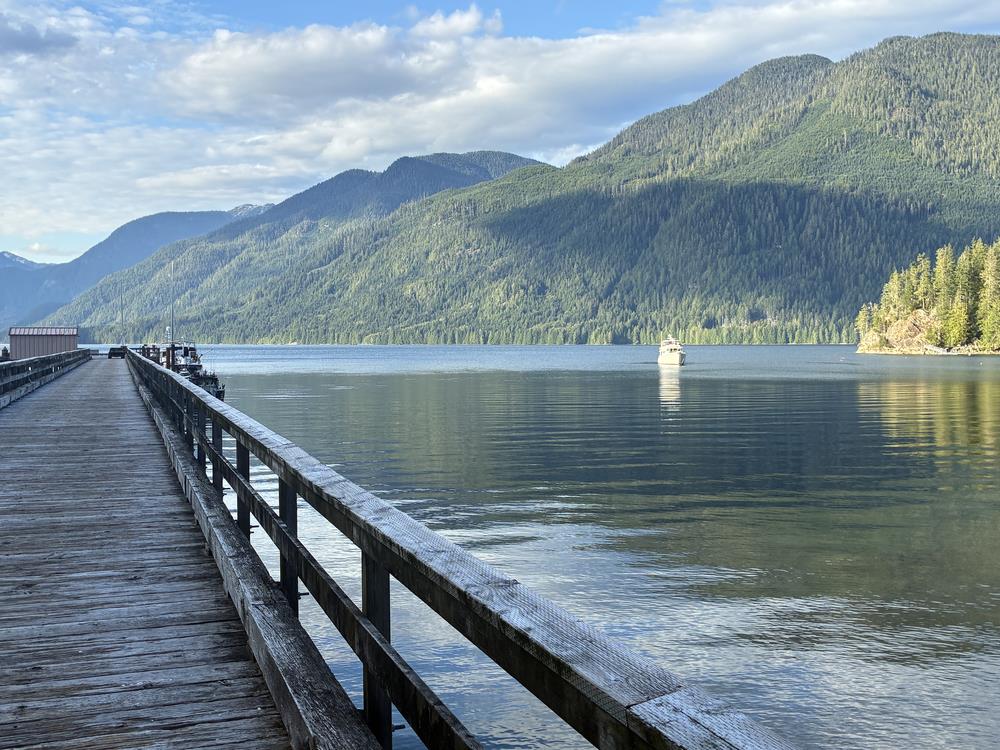
There's a small operation at the head of the Shoal Bay dock that rents rustic cabins upland of the beach with a nice picnic shelter and fire pit. Those facilities are also available to people tied to the dock. I launched the dinghy and went into the dock just to do a little bit of exploring.
Shoal Bay was just a stop-over for us before running down Chancellor Channel and coming out into Johnstone Strait. Johnstone Strait has a deserved reputation for always being windy with very strong current. When the wind and the tide are against each other, the strait has short, steep, nasty chop.
Today, however, Johnstone was very tame. We got out into Johnstone a little before noon and the wind light--under 10 knots. Better yet, what little wind there was and the current were going in the same direction. Admittedly, both were against us, but it made the seas almost completely flat--which was very welcome.
The plan was to run down Johnstone strait about 12 miles and if the wind and chop picked up, we'd duck into Port Neville for the night. However, as we got to Port Neville, the wind was still no more than about 12 knots and the seas were still quite comfortable, so we decided to press on to Havanna Channel.
Our goal was to check out a small anchorage we'd never used before called "Burial Cove". Hmmm.....really? Is that a good idea? Well, Burial Cove proved to be harmless, though, frankly, not particular scenic. It's a small cove with a dock and floating building on one side and a dock on the opposite side. There was still enough room for us to anchor for the night, but it was little more than a stop-over.
The real goal was to get to Cracroft Inlet, which is close to the well-known "Lagoon Cove Resort Marina". Now....for those of you who haven't cruised in the Pacific Northwest, especially in British Columbia and Alaska, you have to understand that "Resort" in these waters has a pretty different definition than you may be used to in more developed areas. There are many so called "Resort Marinas" in British Columbia, and a few in Alaska. A "resort" in this context just means that it's a marina for pleasure boats (not commercial boats) and many of them have some limited facilities for boaters to get together to share drinks or hors d'oeuvres. That's about the extent of the "resorts" here. Some are more developed than others, but if what you have in mind is places like Atlantis in the Bahamas, you're going to be sorely disappointed (or maybe thrilled).
Prawning at Cracroft Inlet
We weren't planning to go into Lagoon Cove. It's not a bad spot, but we didn't really feel like we needed to tie up at a marina. There's a good anchorage just on the other side of Dorman Island from Lagoon Cove. My primary reason for wanting to stop here was that in the past, I've done really well setting shrimp pots out in Clio Channel. So.....we anchored about noon right after lunch, I got started getting things ready to go set shrimp pots. I was really hopeful!
That evening, I debated about whether to go get the pots or to wait till the morning. I knew there would likely be no wind at all in the morning, which would make the dinghy ride out to the pots easier, but there could also be fog. It's about a 15-minute high-speed dinghy run to where the pots were set and it would take a lot longer if I had to go slow in the fog.
So....I decided to go pull the pots at about 8 pm (still plenty of daylight at these latitudes). The dinghy ride out wasn't flat, but it wasn't too jarring either.
Shrimping is a lot of work. The pots have to be set in a minimum of about 250 feet of water, and often in 350-450 feet. It takes considerable time both to let a pot sink through 300 feet of water and just as much or more time to pull it back up. It's pretty discouraging when you go through all that and get very few prawns. This was one of those times. Between two pots, we got 12 prawns! ARG! Enough for a small meal, but that's it! Last time, I got over 150 in the same place! Bummer!
Fishing at Farewell Harbor
We left Cracroft Inlet the next morning and headed to Farewell Harbor, where we planned to fish for salmon. The run from Cracroft to Farewell Harbor was only a couple of hours, so we got there about noon and got setup to go out and troll for salmon on the afternoon slack tide. Once again, we were disappointed! Are you hearing a pattern?
We ended up going out on the Thursday afternoon slack, then going out again early Friday morning (we had poles in the water at 6 am!). Then, we made one last desperate attempt Friday afternoon at the slack. Through all three attemps all we got one was little "shaker" (a small coho). How sad is that? We tried three different lure/rig combinations, several different depths, and three different times. All for naught.
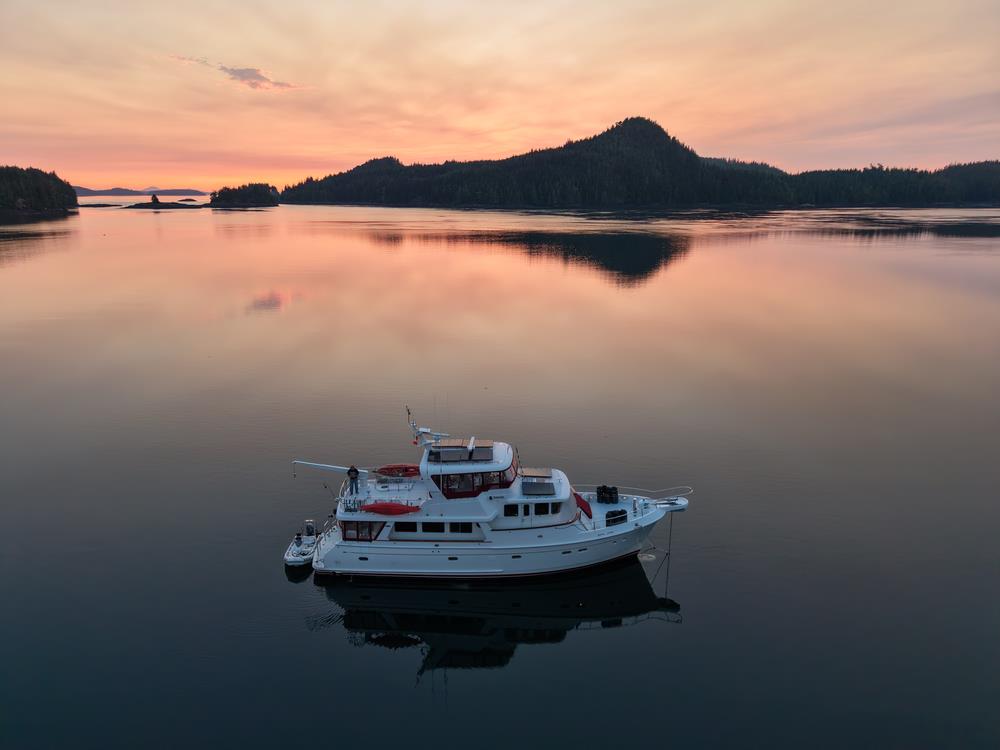
The one up-side is that we had beautiful sunsets both evenings! However, on Friday afternoon, as we started heading back toward the boat, dark clouds had started to gather and we heard a couple of claps of thunder. We decided it was time to get out of there. We ran back to the boat and just as we were tying up to the stern of Koinonia, we heard and saw a flash of lightning and a deafening clap of thunder. I don't think the lightning ever actually touched down---we think it was just between the clouds, but it must have been directly over us because the flash and the clap of thunder were simultaneous and the clap was so loud it almost hurt!
Good time to get off the dinghy and into the shelter of the big boat. We heard a few more rumbles, but nothing as close and terrifying as that one.
Sullivan Bay: a night with shore power!
It's now been ten days since we were tied to a dock with shore power. That's by no means a record or even a particular hardsship, but it is nice to be able to top-up the batteries, do some laundry and a few other things without running the generator. So, we decided to spend one night at Sullivan Bay Marina.
Sullivan Bay is an interesting marine in the Broughtons. There's nothing really there--it's a group of floating homes and docks tucked into a cove. The marina is a coop with the homeowners and some private owners. Renting transient moorage in the summer helps subsidize mainenance on the docks and other infrastructure. There's no utility power, but they have a diesel generator tucked away in a building in the corner of the marina, and it's well insulated so you don't generally hear it unless you're right next to it. Shore power is expensive (about $50 US for 50 amp power) but it's nice to be able to plug-in and get a few power-hungry things, like laundry done..
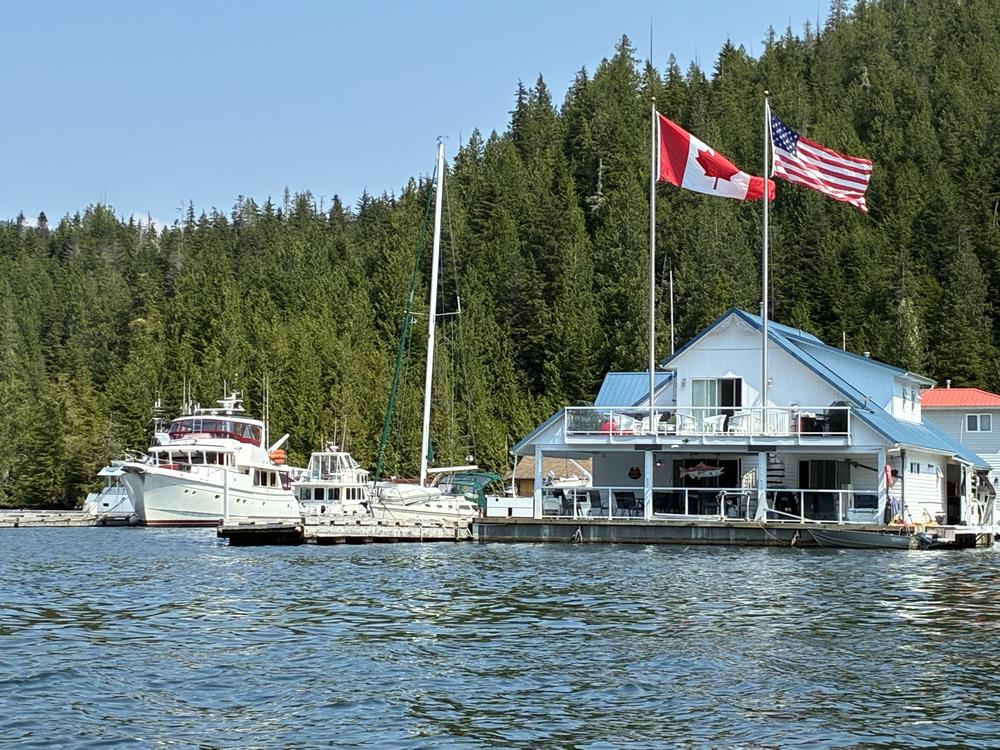
Sullivan also has the typical "Happy Hour" on the dock at 5 pm. There's also a small restaurant here, but they only serve dinner three nights/week. We had a fun time at the Happy Hour Saturday evening. Then, Sunday, late morning, we went to the restaurant for their "brunch", which was really good. A little on the spendy side, but given what they have to do to get the food there and prepare it, non at all unwarranted. I really enjoyed eggs benedict!
Finally! The Fishing drought is over!
The plan was to leave Sullivan Bay late Sunday morning and head toward Booker Lagoon. However, Booker Lagoon as a tidal rapid entrance, so we couldn't really go into Booker until about 5 pm. That leaves plenty of time to fish along Wells Passage.
We'd seen a number of boats fishing along the north wall of Wells Passage on the way in and it looked like a good spot. We needed to kill a few hours before we could go into Booker anyway.....so why not give it a try?
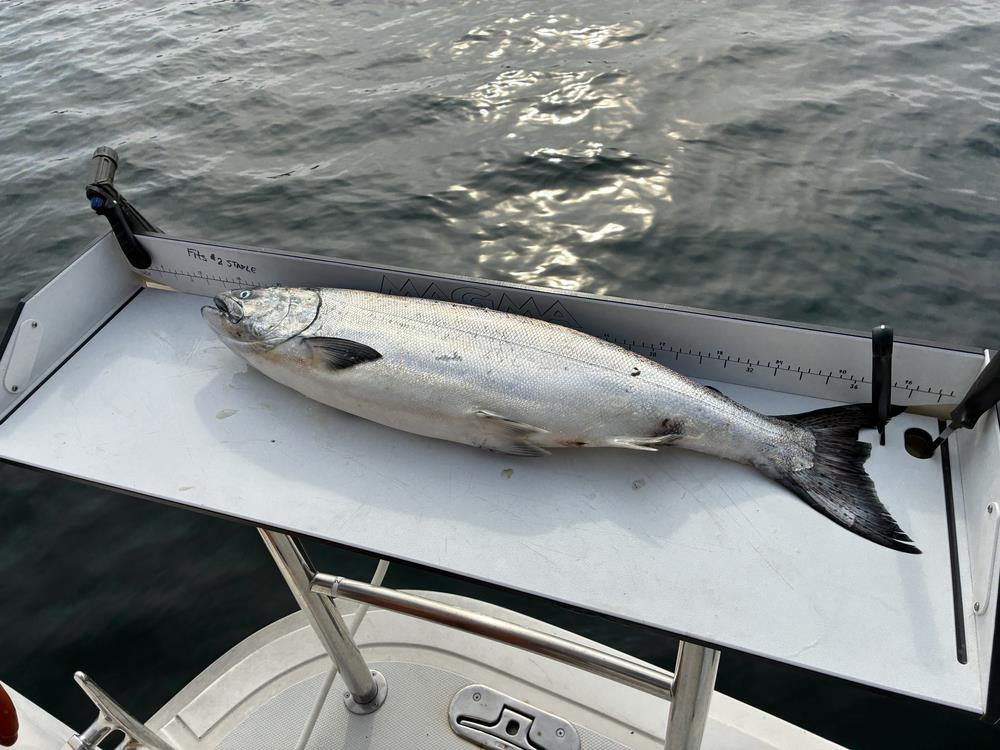
We started fishing at Pandora Head--just around the corner from Sullivan. As we crossed the mouth of Morris Inlet, we got our first strike. It was a small king that we released. Then, as we got most of the way across Morris Inlet towards Compton Point, we got a nice strike with a wild coho. Fortunately, in this region, we can keep 1 wild coho ("silver") and 1 wild king ("chinook"). Then, just as we were about to call it quits, we got a really nice strike and landed a roughly 13 lb. wild King. Beautiful fish! Salmon for dinner tonight! It was also great to have the "drought" of catching behind us!
Another change of plans...
The best kind of cruising is without a plan.....but there's a certain amount of planning pretty much required here, especially because of the abundance of tidal rapids.
We've really enjoyed Booker Lagoon in the past. It's a kind of star-shaped lagoon with four main fingers off a central bay in the middle with a deep prawning hole. That was one of the reasons I wanted to go in. It's late in the season, so it's likely the pranws would be mostly gone, but I have one more batch of bait cups made up and I planned to spend them on one prawn trap set in the hole at Booker.
The entrance to Booker Lagoon is quite narrow--roughly 50 feet--and it's a tidal rapid, so you really have to go in and out at slack. After we got done fishing, we headed in that direction, but I kept having to slow down to avoid getting there too early.
In the meantime, the call of the grandkids had started (as it often does) impacting our plans. Our grandson's, birthday is Sunday, and Roseanne said that she'd really like to get back for his birthday party. We were originally going to meet them in the San Juans and celebrate his birthday aboard. For a variety of reasons, that didn't work out, so the birthday party was going to be at my daughter's house.
No problem.....we'll just cut out the extra day we were going to spend at Booker Lagoon before starting our way back. The only problem with at is that it means we have different slack current times for leaving Booker Lagoon. In our original plan, the morning slack was just before 6 am, so it would have been an early morning, but it was about sunrise, so visibility through the narrow passage would have been fine.
Leaving a day earlier put the morning slack at just before 5 am, so now it was going to still be dark when we'd have to transit Booker Passage, or we'd have to wait till 11, which would give us a pretty late start for the longer run down to Forward Harbor.
In the end, we made the decision to bypass Booker (and the potential prawns) and head to another anchorage that was on our way home and doesn't require a tidal rapid entrqance. We spent a lovely evening in Sunday Harbor and actually ran across another Selene Owner in there. The new Selene Map functionality even sent me an email alert to tell me that there's a "nearby Selene". How fun is that?
On the way home
It seems like every year when we go cruising, we have this plan to meander slowly south on our way home, but something breaks in and pushes the accelerator pedal. This year it was my grandson's birthday. We'd really like to be there for his party, so we're pushing the return date up a bit.
Tonight we're in Douglas Bay in Forward Harbor. It's a nice quiet anchorage and we are--once again--with another Selene! (They are everywhere!). This time is the Selene 55 "Hyperion" with the owner Matt and a couple of others on board! It's always fun to cross paths with another Selene owner! Tomorrow, we'll run about 40 miles down to Campbell River (through Seymour Narrows) and then we'll do a long day from Campbell River to Nanaimo, where we'll be picking up the new alternator to replace the one that failed in Campbell River on the way up!
We'll be home for about three weeks before we turn around and head north again---this tie to get Koinonia's routine bottom paint job done and then head to Princess Louisa Inlet with Chris and Elisabeth, and anyone else who wants to join us!
Stay tuned for more fun!
Go to the Previous Post