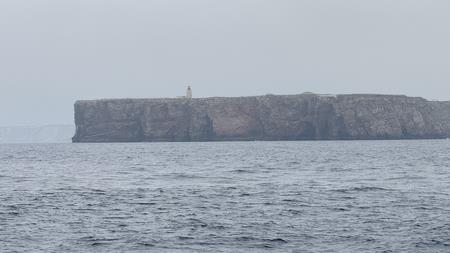
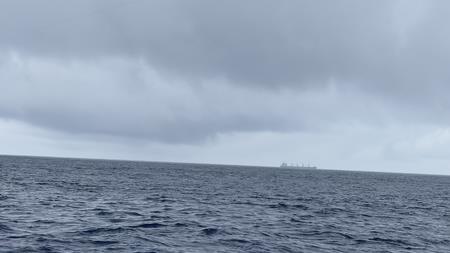
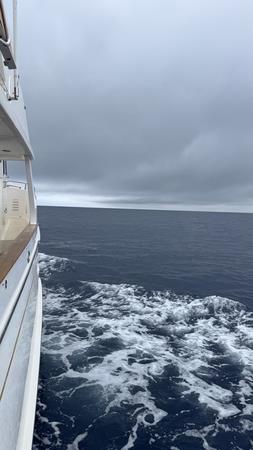
First 24 hours in the books — 147 nautical miles in our wake, and nothing but open ocean ahead.
We slipped our lines in Portimão, a wonderful little coastal town on the Algarve that treated us well -- it's not "good bye" it's "see you later" kind of place. It's the last land we'll see for over six days. There's a particular feeling to watching a coastline drop below the horizon when you know the next one is 800 nm and the better part of a week away — equal parts thrill and "well, no turning back now."
The morning and early afternoon were the kind you'd put on a postcard: full sun, winds around 10 knots, the boat settling into her offshore rhythm. Then, right on cue, the Atlantic reminded us who's in charge. Just as dinner was coming together — beef stroganoff, my Father's Day request, because if you can't pull rank on the galley on Father's Day, when can you? — the wind piped up to 22–26 knots, parked just ahead of the starboard beam. That put a nice roll into the boat, and cooking over a pot of boiling water in those conditions is a real challenge — not for the faint of heart. The credit goes entirely to my wonderful wife Shawna, head chef, and her sous-chef Lexi, who together pulled off a proper Father's Day meal in a galley that wouldn't sit still. Dinner was served, nothing ended up on the ceiling, and I'm a lucky guy. I'm calling it a win.
Before all that, we threaded our way through the busy Traffic Separation Scheme off Cabo de São Vicente — the southwest corner of Europe and a genuine highway for ships, where the move is to cross with purpose and keep your head on a swivel. Once clear, we turned and settled onto our great-circle route for the Azores. The wind kept up its enthusiasm through the evening and finally eased off just after midnight, handing us back the calm we'd been promised.
The boat is doing exactly what we ask of her. She's sipping 2.4 gallons an hour and holding about 2.55 nautical miles per gallon — all systems nominal, which is my favorite phrase in any language. At that efficiency the fuel math isn't just comfortable, it's the entire reason this crossing works. Which brings me to the part of the day that keeps it that way. A passage like this is really a series of small disciplines, repeated. Every couple hours I do a lap of the engine room — eyes, ears, and the infrared digital thermometer on things that should be a certain temperature and not warmer: belts, hoses, the raw-water strainer, shaft seal, a peek in the bilge. Fuel gets its own ritual. I transfer between tanks to keep a working supply fed and the boat trimmed, run every drop through the polisher, and then reconcile three numbers that should agree but never perfectly do: what the flow meter says we burned, what the tanks say is left, and what the day's run says we should have used. When those three roughly line up, I sleep better. When they don't, I go find out why before they become a story.
There's one more chore, and it's the counterintuitive one. Loafing along at ~1,000 rpm is fantastic for range but lousy for a diesel — run any engine at light load long enough and you get wet stacking: unburned fuel and soot building up in the exhaust and turbo because the engine never gets hot enough to clean itself. The fix is simple and a little satisfying: once a day I throttle her up under load for a good stretch, get the exhaust temps up where they belong, and let her burn off what the slow miles leave behind. Think of it as a daily hard reset for the engine. It happens every day, weather permitting, and the boat is visibly happier for it.
First night offshore: in the books.
Follow the dot: trackmywake.com/wake/next-chapter.
— Chris & the crew of Next Chapter